If you want to build an email list for affiliate marketing, the goal is not just more subscribers—it is a relevant audience that trusts your content and recommendations.
An email list is one of the few marketing assets you can build where the relationship does not depend entirely on a search engine or social feed deciding whether to show your next message. But simply adding a newsletter box to a website is not a strategy.
A list grows when the offer to subscribe is clear, the lead magnet solves a specific problem, the signup experience is easy, and the emails that follow make the subscriber glad they joined. This guide walks through that system from zero.
See our Free Magnet Bot AI Review 2026 for its lead-magnet generator, squeeze pages, email copy, traffic tools, current price and upgrade funnel.
Quick Takeaway
This guide is designed to help you make a practical decision, not to push the largest possible software stack. Start with the job you need done, use the smallest set of tools that supports it, and expand only when your workflow gives you a reason.
In This Guide
- Start With the Subscriber Promise
- Create a Lead Magnet People Actually Want
- Build a Focused Opt-In Page
- Write a Useful Welcome Sequence
- Choose Two Traffic Sources
- Create a Sustainable Newsletter Rhythm
- Segment Only When It Helps
- Measure the Right Numbers
- Handle Consent and Unsubscribes Properly
- A 30-Day List-Building Plan
Start With the Subscriber Promise
Before choosing an email platform, decide why someone should hear from you again. A good subscriber promise is specific enough that the reader knows what will arrive and relevant enough that the promise naturally connects to your site's main topic.
For a marketing software review site, that promise might be practical tool comparisons, important pricing changes, short buying guides and occasional checklists that help readers choose software more confidently. The promise should not be “join my newsletter.” The newsletter is the delivery mechanism, not the value.
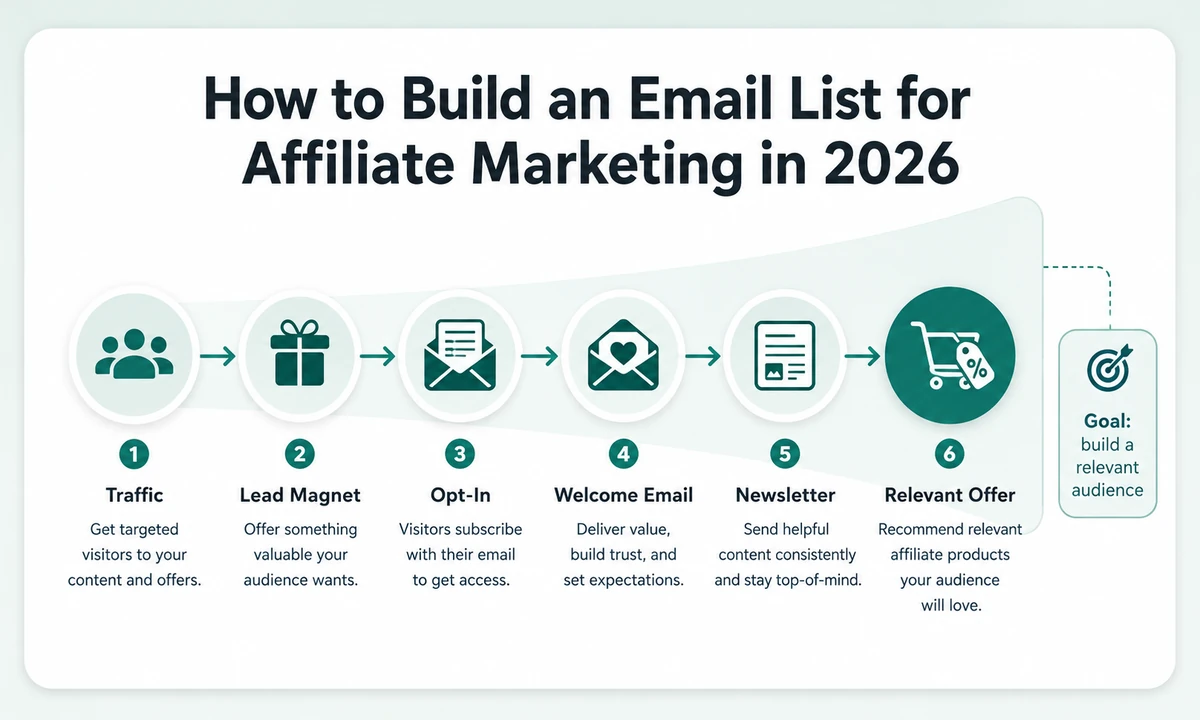
A simple email list funnel connects targeted traffic to a useful lead magnet, welcome sequence and relevant offers.
Create a Lead Magnet People Actually Want
A lead magnet is useful when it solves a narrow problem quickly. Broad ebooks often sound valuable but require too much time from the subscriber. Checklists, templates, worksheets, swipe files and short decision guides can be easier to consume.
If your lead magnet starts as a Word, text or Markdown document and the formatting step is slowing you down, our Rebrand My PLR review examines a browser-based workflow for turning that source file into a branded PDF.
Match the resource to the page where the visitor discovers it. Someone reading a guide about choosing AI tools might value an “AI Tool Evaluation Checklist.” Someone comparing email platforms may prefer a “Email Platform Migration Checklist.” Relevance usually beats size.
Good lead magnet characteristics
- Solves one clear problem.
- Can be understood quickly.
- Feels directly connected to the article or category.
- Produces a result rather than merely providing more reading.
- Sets up the topic of your future emails naturally.
Build a Focused Opt-In Page
Your opt-in page does not need a complex design. It needs a clear headline, a short explanation of the benefit, a visual of the resource if appropriate, a form and a clear privacy expectation.
Remove unnecessary navigation when the page is used as a dedicated landing page. If the form appears inside a normal article, keep the call to action compact and contextual so it does not interrupt the reading experience.
What the form should explain
- What the visitor receives.
- Where it will be delivered.
- What kind of future emails they can expect.
- That they can unsubscribe.
After signup, send the subscriber to a useful confirmation page. Do not leave them wondering whether the form worked.
Write a Useful Welcome Sequence
The welcome sequence has two jobs: deliver what was promised and establish why the subscriber should continue opening your emails. A simple sequence is often enough.
| Purpose | What to include | |
|---|---|---|
| 1 | Deliver | Lead magnet link, short welcome, what happens next |
| 2 | Orient | Your best guide or framework related to the signup topic |
| 3 | Help | A practical mistake to avoid or a useful checklist |
| 4 | Recommend | A relevant resource, comparison or product only when it fits |
Avoid turning the first four emails into four sales pitches. The sequence should teach subscribers what kind of value they can expect from staying on the list.
Choose Two Traffic Sources
An opt-in form does not create traffic. Pick one primary traffic source and one secondary source you can sustain. For many content sites, search can be the long-term source while YouTube, Pinterest, a community or social content provides additional discovery.
Do not spread yourself across six channels because each one is “free.” Every channel has its own content format, learning curve and feedback loop. Two channels executed consistently usually teach you more than six channels used occasionally.
Place relevant signup opportunities on high-intent pages. A generic popup on every page may produce subscribers, but a contextual offer inside a useful guide can produce subscribers who are more aligned with your future content.
Create a Sustainable Newsletter Rhythm
Consistency matters more than sending frequently. A weekly email can work well for a content site, but every two weeks can be better if that is the schedule you can maintain without filling messages with weak content.
A practical newsletter format is:
- one useful idea or observation;
- one new or updated article;
- one tool, resource or comparison worth considering;
- one clear call to action.
Write for a reader, not for an “email blast.” Short, clear messages often outperform over-designed newsletters when the goal is to build trust and send people to useful content.
Segment Only When It Helps
Segmentation is valuable when different subscribers genuinely need different messages. A review site might eventually separate people interested in AI tools, email marketing or affiliate software. But segmentation creates maintenance work, so do not build an elaborate tagging system before you have enough subscribers to benefit from it.
Start with one or two meaningful signals: which lead magnet the person requested and perhaps which broad topic they selected. Add sophistication after the list has enough activity to justify it.
Measure the Right Numbers
Free planning tool: Use the Email List Value & Growth Calculator to estimate revenue per subscriber, churn value and 12-month list growth.
Connect traffic to business value: The Which Pages Actually Make Money? analyzer can compare landing-page traffic with conversion or revenue data, while the Bot vs Human Traffic Detector can flag suspicious traffic that may inflate top-line visit counts.
Open rates are useful but imperfect because privacy features can affect how opens are recorded. Focus on a group of indicators rather than one number.
- Signup conversion rate: are visitors accepting the offer?
- Click rate: are subscribers taking useful actions?
- Unsubscribe rate: are expectations and frequency aligned?
- Reply rate: are people engaged enough to respond?
- Revenue or goal completion: does the list support the business?
Track performance by source when possible. Ten subscribers from a highly relevant guide can be more valuable than fifty from a broad giveaway.
Use a Simple Email-List Economics Framework
Raw subscriber count is not enough to judge whether list building is working. Track the chain from acquisition to revenue so you can see where the economics break down.
| Metric | Simple calculation | What it tells you |
|---|---|---|
| Cost per subscriber | List-building spend ÷ new subscribers | What it costs to acquire one subscriber. |
| Revenue per subscriber | Email-attributed revenue ÷ active subscribers | How much value the current list creates over the chosen period. |
| Payback ratio | Revenue per subscriber ÷ cost per subscriber | Whether acquisition economics are improving or deteriorating. |
| List churn | Unsubscribes + invalid contacts relative to starting list | Whether growth is being offset by loss or poor-quality acquisition. |
These are management metrics, not promises of future income. If you already have list and revenue data, use the Email List Value & Growth Calculator to model the effect of growth, churn and revenue assumptions without pretending there is one universal “value per subscriber.”
Handle Consent and Unsubscribes Properly
Email marketing has legal and platform requirements. Use accurate sender information, provide a working unsubscribe mechanism, respect consent requirements that apply to your audience and avoid adding people to marketing lists simply because you obtained their address somewhere else.
Your exact obligations depend on where you and your subscribers are located, so the safest approach is to configure your email provider according to its compliance guidance and get legal advice when your situation requires it.
A 30-Day List-Building Plan
Week 1: Define the offer
Choose the subscriber promise and build one focused lead magnet tied to your most important content topic.
Week 2: Build the path
Create the opt-in form or landing page, thank-you page and first welcome email. Test the entire process yourself from signup through delivery.
Week 3: Publish supporting content
Add the opt-in to two or three relevant articles and create one dedicated guide that naturally leads to the resource.
Week 4: Improve with data
Measure page visits, form conversions, clicks and unsubscribes. Improve the offer or placement based on behavior instead of adding more software.
The Goal Is Not a Big List
The goal is a list of people who understand why they subscribed and want the information you plan to send. Relevance is more valuable than raw subscriber count.
Build the system once, keep the promise clear and improve each step gradually. That approach is slower than chasing giveaways, but it produces an audience you can actually serve.
Lead Magnet Ideas by Reader Intent
The strongest lead magnet is usually a natural next step from the page the person is reading. Instead of creating one giant resource for the entire website, think in intent groups.
| Reader intent | Lead magnet idea | Why it fits |
|---|---|---|
| Choosing software | Comparison worksheet | Helps organize the buying decision |
| Starting affiliate marketing | Beginner tool-stack checklist | Turns a broad topic into an action plan |
| Evaluating AI tools | AI tool evaluation scorecard | Gives the reader a reusable framework |
| Building email campaigns | Welcome-sequence template | Helps the reader implement immediately |
| Growing a YouTube channel | Video publishing checklist | Supports a repeatable workflow |
You can start with one sitewide resource, then create category-specific resources after you have enough traffic to know which topics deserve their own offer.
Build Deliverability Habits From Day One
Deliverability starts with authentication and permission, not subject-line tricks. Google's current Email sender guidelines require all senders to Gmail accounts to use SPF or DKIM, use TLS for transmission and keep spam rates reported in Postmaster Tools below 0.3%. Senders delivering more than 5,000 messages per day to Gmail accounts face additional requirements including SPF and DKIM, DMARC and one-click unsubscribe for marketing/subscribed messages.
Legal compliance matters as well. The FTC's CAN-SPAM compliance guide requires accurate header information and subject lines, a valid physical postal address, a clear opt-out method and honoring opt-out requests within 10 business days.
Do not buy email lists. Purchased contacts did not ask to hear from you, tend to engage poorly and make it harder to distinguish a healthy audience from a large number in a dashboard. Build the list from people who knowingly requested your content.
Keep your list clean over time. If subscribers stop engaging, use your provider's re-engagement and suppression tools where appropriate. The goal is not to preserve the largest possible subscriber count; it is to maintain a responsive, permission-based audience.
| Deliverability check | Practical action |
|---|---|
| Authentication | Verify SPF/DKIM and, when applicable, DMARC before scaling sends. |
| Permission | Send to people who knowingly subscribed; do not purchase lists. |
| Complaint rate | Watch provider/Postmaster data and fix the source of unwanted mail quickly. |
| Unsubscribe | Make opting out easy and process requests promptly. |
| List quality | Remove invalid contacts and review persistently inactive subscribers. |
How to Improve Opt-In Conversion Without Becoming Annoying
Start with relevance before changing button colors or adding more popups. If the article is about choosing email software, a generic “marketing tips” form is weak. A platform comparison checklist is a more logical next step.
Test one variable at a time: the lead-magnet promise, placement, form headline or call to action. A major redesign changes too many variables to teach you much. Also watch whether higher signup conversion produces worse subscribers. A very aggressive giveaway can increase signups while lowering email engagement.
Good placements include the end of a useful section, a compact box near the middle of a long guide and the conclusion. A sitewide header or sidebar form can supplement those placements without interrupting the article.
Create an Email Content Map
Before sending regularly, define three or four repeatable email categories. For IM Review HQ, those could be tool-buying frameworks, new review alerts, important product updates and practical marketing workflows. A small set of themes makes it easier to stay consistent without repeating the same pitch.
Map each email to one action. Some messages should simply teach. Others can send readers to a new guide, a review or a useful resource. When a product recommendation is appropriate, explain why it fits the topic instead of dropping an unrelated affiliate link into the message.
Email List FAQ
How many subscribers do I need before sending a newsletter?
You can start immediately. Early subscribers are useful because they help you learn what people click and reply to before the list becomes large.
How often should I email?
Use a schedule you can sustain. Weekly is common, but every two weeks is better than a weekly schedule that forces you to send weak content.
Do I need multiple email sequences at the start?
No. Begin with one welcome sequence tied to the main lead magnet. Add segmentation and specialized sequences after the list and content library grow.
Should every email contain an affiliate offer?
No. If every message is promotional, subscribers quickly learn that opening your emails rarely teaches them anything. Mix education, useful resources and relevant recommendations.
Browse IM Review HQ's review section for research-based product reviews with pricing checks, evidence, tradeoffs and buyer-fit analysis.
Our Content Distribution & Email Tools guide shows how email fits with internal links, social distribution and repurposing.